Your body is asking for your attention
Sep 30, 2026
Perhaps it starts halfway through a working day. That familiar ache in your shoulder is back, and you really don't have time for it. You shift in your chair, try to find a comfortable position and carry on. If it eases enough to forget about, all the better.
It's an understandable response. You have things to do. You'd like to get through them without hurting, and if you've been dealing with the same pain for months, you may be thoroughly fed up with it.
Being asked to pay more attention to it might sound irritating. Surely you've given it enough attention already.
But there's a difference between being preoccupied with pain and feeling what you're doing while it hurts. You can spend hours wishing it would stop without noticing how tightly you're holding yourself against it.
What gets your attention
On a day when everything feels fine, how much do you notice your body? You might walk to the shops thinking about what to buy, with very little awareness of your legs. Then a small stone gets into your shoe and your foot becomes hard to ignore.
Pain brings your attention somewhere specific. The Grinberg Method takes this as a starting point: something in the body is asking to be felt. Our response is often to try to feel as little of it as possible.
That creates a conflict. The pain keeps drawing your attention back, while you keep trying to get on with something else. Even when you manage to put it out of your mind, the effort of holding yourself away from it may continue.
This is what we mean by fighting pain. It can be quiet and ordinary. You might be sitting at your desk, answering an email, barely aware that you've stopped breathing freely or that your whole body has stiffened around one sore place.
Getting through the day takes effort
Many of us have had plenty of practice at carrying on. We were told to stop making a fuss, or we learnt that there wasn't much room for how we felt. Sometimes there simply wasn't time. There was a shift to finish or a child to look after.
So ignoring pain can become something you do almost before you've noticed it. An ache appears and
you contract. You get busy. Or you find yourself getting angry with somebody over something small,
because anger feels easier than staying with what hurts.
These responses can be so familiar that they seem like part of the pain itself. If your shoulder hurts and you tighten your jaw every time you feel it, you may eventually experience the whole thing as one miserable state. Separating out what's happening takes attention: there's the sore shoulder, and there's what you do when you feel it.
The second part is what matters because it's something you can learn about. How much effort goes into trying to keep the pain out of your day? Does that effort stop when you stop working, or are you still holding yourself in the same way on the sofa that evening?
The Grinberg Method asks you to notice this conflict, including the moments when the pain becomes too insistent to push aside. This doesn't tell us why a particular pain has arrived or why it keeps returning, but it gives us somewhere to look at - our own response, alongside whatever medical care is needed.
Learning to stop fighting it
If you're used to contracting against pain, which most of us do, letting yourself feel it can be an unsettling idea. You might expect it to overwhelm you. Even the suggestion to relax can sound like one more thing you're supposed to be able to do and can't.
This takes practice. In the Grinberg Method, a practitioner helps you recognise the things you do automatically when something hurts. You might discover that you're holding your breath or become tense, and learn to stop doing that. Something that happened without your noticing becomes something you can recognise as it happens.
There may be fear involved too. If a familiar ache makes you dread the days ahead, that dread is part of what you're experiencing. You can begin to notice it along with the physical sensation, without needing to explain where every feeling comes from.
The aim is to become able to feel more without immediately tightening against it or trying to escape. That ability can develop. It doesn't require you to like pain, and there's no promise that paying attention will make it disappear.
What you are learning to stop is the extra work of fighting it. If you've been doing that for a long time, you may only realise how much effort it took when you begin to let it go.
Something to notice
With a familiar, everyday ache, you might be curious about your first response. Perhaps you draw in a breath and hold it. Perhaps your jaw tightens, or you immediately reach for something to occupy yourself.
You don't have to turn this into another job or spend the day monitoring yourself. Just noticing one response can be a useful beginning. It gives you something specific to learn to stop, even while the pain itself remains uncertain.
* The Grinberg Method is an educational approach, not a medical treatment, and it does not diagnose or cure. For severe, sudden or unexplained pain, see a doctor.
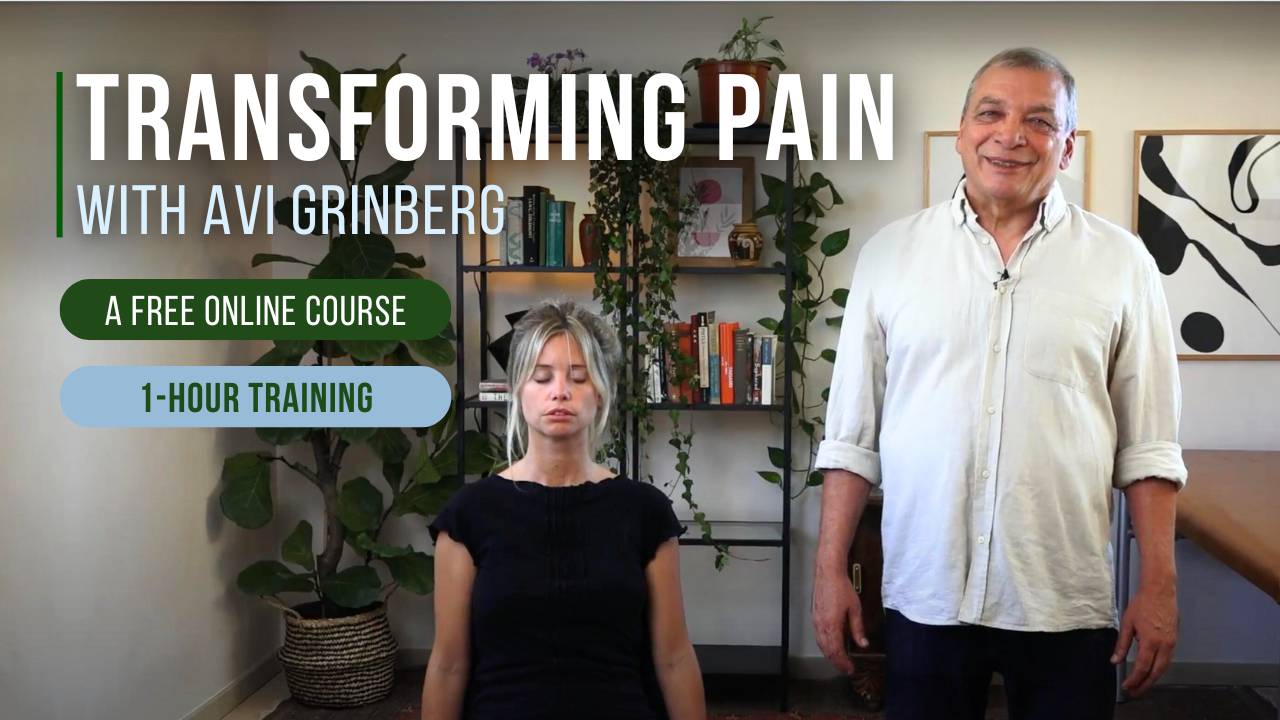
You can explore this approach in our free Transforming Pain course. Get the course.
A Grinberg Method practitioner can help you recognise how you fight pain and teach you to stop those automatic responses.
Stay connected with news and updates!
Once a month, we’ll share upcoming events, community stories, special offers, and new ways to learn with the GM community.
We hate SPAM. We will never sell your information, for any reason.